Childproofing the cupboard under the sink
The cupboard under the sink is low, latch-free and full of bottles. How to empty it of the worst products, choose a latch that suits it and keep checking it.
 By Rosemary Tilson9 min read
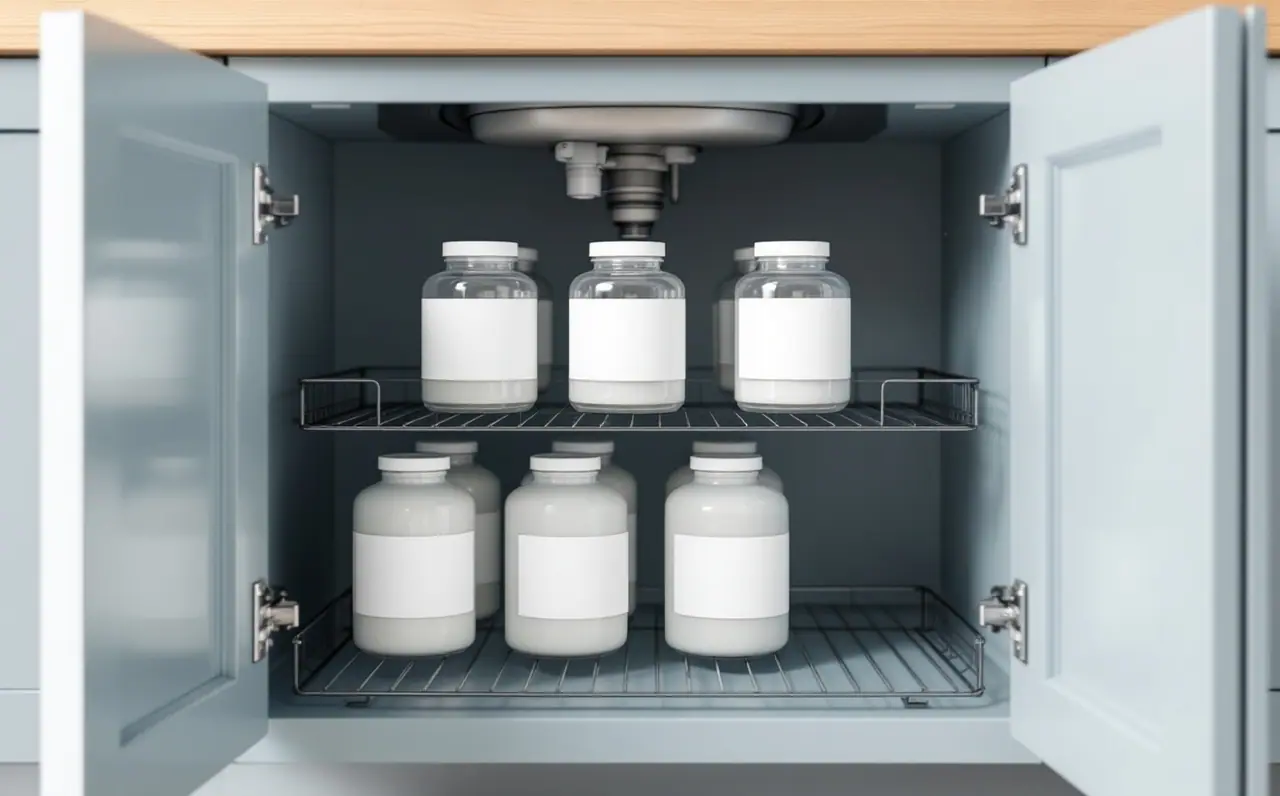
Every kitchen I have lived in has had the same arrangement. The sink sits on top, the pipes run down behind a pair of doors, and the space around the pipes fills up with whatever needs to be near water: dishwasher tablets, washing-up liquid, bleach, a drain opener, a spare sponge and a bottle of something bought for one job three years ago. It is the most convenient cupboard in the house for an adult. It is also exactly at the height of a crawling baby, it usually has no lock, and the doors open with one pull.
Childproofing it is not one job. It is three: deciding what lives there, fitting a latch that suits the door, and checking that latch every so often as the child in the house grows. This piece takes them in order and finishes with a room-by-room checklist for the other low cupboards that tend to collect the same kind of bottle.
Why this one cupboard matters so much
Young children explore with their hands and mouths, and they copy what they see adults do. The US Consumer Product Safety Commission makes that point in its Lock Up Poisons guide: children are curious about the things adults use, and pretty colored liquids and containers catch their attention. A cupboard full of bright bottles at floor level is about as tempting as a kitchen gets.
The same guide gives the storage rule in plain words. Keep household products and medicines out of sight of children, in a cabinet or closet that locks or has a child-resistant latch. Keep products in their original containers. Use child-resistant packaging and close it properly after every use. Store household products away from food and medicines.
The cupboard under the sink breaks most of those rules by default. It is in sight, it is low, it has no latch, and it often sits right next to the cupboard where the food goes.
Step one: take everything out
Before you buy a single latch, empty the cupboard onto the kitchen floor or a table. It takes ten minutes and it is the most useful part of the whole job, because most of us have no clear idea of what is in there.
Sort what comes out into three piles:
- Products you use every week, often at the sink.
- Products you use occasionally.
- Products you no longer use, cannot identify or have doubled up on.
The third pile usually surprises people. An old drain opener with a cracked cap, a second bottle of the same cleaner, a tin of furniture polish from a previous home. Anything you do not need can leave the house. Check the label for disposal directions and your local council or city for its household hazardous waste arrangements, rather than pouring it away or mixing leftovers together.
A worked example: one family's cupboard
Here is what a typical under-sink audit might turn up, and where each item ends up afterwards. This is an illustration, not a list of what you must own.
| Item found | Signal word on the label | Where it goes |
|---|---|---|
| Washing-up liquid | none or Warning | Stays, behind the latch |
| Dishwasher tablets in a tub | Warning | Moves up to a high cupboard, lid closed |
| Thick bleach | Danger or Warning | Moves up to a high cupboard |
| Drain opener | Danger | Moves up, or out of the house entirely |
| Oven cleaner | Danger | Moves up |
| Multi-surface spray | none or Caution | Stays, nozzle turned to off |
| Shoe polish and a can of air freshener | Warning | Moves to a high shelf elsewhere |
| A refill pouch of hand soap | none | Stays |
The rule behind the table is simple. The products with the strongest signal words go up and away, and only the mildest, most-used items stay under the sink, still behind a latch. If you are not sure what the word on a bottle is telling you, our guide to signal words on labels explains how Danger, Warning and Caution rank.
Laundry and dishwasher capsules deserve a special mention. They are small, soft, brightly colored and easy to squash, and they are one of the products that is far better on a high shelf than under any sink. Our piece on laundry capsule storage covers the habits that go with them.
Step two: move the worst products up and out
Height is your first line of defense and the latch is the second. A latch can fail, be left open or be solved by a clever child. A bottle on a high shelf, inside a closed cupboard, gives you two barriers instead of one.
Good places for the products you moved:
- A wall cupboard above the worktop, ideally one that also has a latch or lock.
- A high shelf in a utility room or pantry, at adult head height.
- A lockable box on a high shelf, for the few products you really want kept apart, such as a drain opener or oven cleaner.
Try to keep them away from food. A shelf of cleaning products directly above the bread or the cereal is not ideal, because a leak or a mix-up is easy. If space forces cleaning products into the same tall cupboard as food, put the cleaning products on their own shelf, never above food, and keep them in their original containers with the labels facing out.
Avoid tall stacks. A child who cannot reach a bottle can still pull a stool over, climb a drawer or tug at a stack until it falls. Keep high storage tidy enough that nothing tips when the door opens.
Step three: choose a latch that suits the door
Once the cupboard holds only the mildest products, it still needs a latch. Children do not read labels, and even washing-up liquid is not something you want a toddler drinking or squirting into their eyes. The main types available for home cupboards are below.
| Latch type | How it works | Good for | Watch out for |
|---|---|---|---|
| Adhesive strap | A flexible strap sticks across the outside of two doors or a door and frame; you press a button to release it | Rented homes, doors you cannot drill, older children's quick checks | Adhesive can loosen with steam and heat near a sink or kettle |
| Spring catch (push-down hook) | A plastic hook screws inside the door and catches on a strike plate; you push the hook down to open | Single doors, cheap and quick to fit | The door opens a few centimeters, enough for small fingers to pinch or reach in |
| Magnetic lock | A hidden lock inside the door releases only when a magnetic key is held against the outside | Kitchens where you want no visible hardware | The key must be kept somewhere high and remembered; fitting needs care |
| Sliding lock | A U-shaped bar slides through the two handles of a pair of doors | Double doors with knobs or loop handles close together | Useless on doors without suitable handles; children can sometimes slide it |
| Hook and eye or barrel bolt, fitted high | A small metal fastening at the top of a tall door | Utility doors, pantries and broom cupboards | Only works if fitted out of a child's reach, and only if it is used every time |
For the cupboard under the sink, most people end up with either a spring catch or a magnetic lock, because the doors are used many times a day and a latch that takes two hands gets left undone. If you rent, an adhesive strap is the usual choice. Whatever you pick, follow the maker's fitting instructions closely: a catch fitted a few millimeters out of line will either not hold or will not let you open it, and both lead to the latch being abandoned.
Our safety shelf page lists the kinds of latches, locks and storage boxes that come up most often, if you want to compare them side by side.
Fit it, then try to beat it
After fitting, try to open the door the way a child would. Pull hard on the handle. Pull on the bottom corner of the door instead. Push the door in and then pull, which sometimes jumps a spring catch. Slide a hand into the gap to see what you can reach. If you can get a bottle out without using the release, a child will too, sooner or later.
Step four: check the latch, and the child, regularly
No latch is childproof. Children get taller, stronger and better with their hands, and they watch closely when you open the cupboard. A latch that defeated a one-year-old may be no match for the same child a year or two later, especially one who has seen you press the button a hundred times. There is no reliable age at which this happens; it depends on the child, the latch and how often they have watched.
Some habits that help:
- Check every latch once a month. Look for screws working loose, adhesive lifting, plastic cracking and strike plates moving.
- Close the latch every time, even if you are coming straight back. Most latch failures are latches that were left open.
- Open it out of sight when you can, so the trick is harder to copy.
- Watch for signs a child has worked it out: a door found open, a toy wedged in the gap, a child heading straight for that cupboard.
- When a latch is beaten, change the latch or move the products higher. Do not rely on telling the child no.
Child-resistant caps on the bottles themselves are a useful extra layer, but the CPSC guide is clear that you need to close them properly after every use. A cap that is left loose is just a lid.
Room-by-room checklist
The cupboard under the kitchen sink gets most of the attention, but the same bottles tend to collect in other low places. Walk through the house once with this list.
Kitchen
- Cupboard under the sink: only mild, everyday products, latch fitted and closed.
- Dishwasher: tablets in a high cupboard, door shut between loads, loaded with the detergent added just before you start the cycle.
- Worktop: no cleaning spray left out next to drinks or food after you finish.
Bathroom
- Under the basin: the same audit as the kitchen. Toilet cleaner, bleach and limescale remover go up.
- Bath edge and shower shelf: shampoo and shower gel are not the worst risk, but bright bottles at bath height get handled.
- Medicines: in a high, closed cabinet, never in a wash bag on the floor.
Utility room or laundry area
- Laundry capsules, powder and stain removers on a high shelf with lids closed.
- Floor-level buckets: empty, rinsed and stored dry. A bucket of water with cleaner in it is a hazard of its own.
Hall, bedrooms and living room
- Handbags, coat pockets and backpacks off the floor. They often hold medicines, hand gel and batteries.
- Low drawers with shoe polish, lighter refills or spare batteries: move them up.
Garage and shed
- Fuels, antifreeze, weedkiller and paint products on high shelving or in a locked cabinet, never on the floor.
If something goes wrong
Prevention narrows the chances but cannot remove them. If you think a child or anyone else may have swallowed, breathed in or splashed a product, call your local emergency number or a poison center now, and have the product or its label in your hand when you call. In the US, Poison Help is 1-800-222-1222. In the UK, call NHS 111, or 999 in an emergency. Across the EU, the emergency number is 112. If someone is unconscious, having trouble breathing or having a seizure, call 911, 999 or 112 straight away. Contacts for other countries are on our official help page.
Keep the product, even if the bottle is nearly empty. The label tells the person on the phone exactly what is in it, which is one more reason the cupboard audit ends with everything still in its original container.

Rosemary Tilson
Rosemary has childproofed three family kitchens and one very determined toddler's bedroom. She writes the storage pieces here: latches, heights, cupboards and the habits that keep a bottle where it belongs.