Cleaning & LaundrySafe Storage
Liquid laundry capsules: storage habits for homes with small children
Liquid laundry capsules are soft, bright and burst easily, so they need more care than a bottle. What the tub is designed to do and the habits that matter.
 By Leonie Duval8 min read
Liquid laundry capsules are one of those products that make a chore a little easier. One capsule, one load, no measuring cap sticky with detergent. I use them myself. But they are also a product that needs a different kind of storage from a bottle of liquid detergent, and the reasons are all in the shape of the thing.
A capsule is a dose of concentrated detergent sealed inside a thin film that is designed to dissolve in the wash. The US Consumer Product Safety Commission (CPSC) points out that the film dissolves quickly on contact with water, wet hands or saliva, releasing concentrated chemicals. It also notes that capsules attract children as play items because they are soft and colorful and resemble familiar things like sweets, toys and teething products. A small child who picks one up does what small children do with soft, squashy, brightly colored things: squeezes it, bites it, or rubs their eyes with the hand that held it.
So this piece is about keeping capsules where a child never gets the chance. It covers what the packaging is designed to do, how to read the tub you have at home, and the handful of habits that do most of the work.
What the tub is designed to do in Europe
The European Union added specific packaging rules for liquid laundry capsules to its classification, labelling and packaging regulation (CLP) through a Commission regulation adopted in December 2014. The rules are in Annex II of CLP, section 3.3, and they apply to liquid consumer laundry detergents sold in soluble single-use packaging. Great Britain kept the same section in its own version of CLP, which you can read on legislation.gov.uk.
In plain terms, the outer packaging, meaning the tub, box or bag the capsules come in, must:
- be opaque or obscured, so that you cannot see the product or the individual capsules from outside;
- carry the precautionary statement "Keep out of reach of children" in a visible place and in a format that attracts attention;
- be easy to reclose and able to stand up on its own;
- have a closure that needs a coordinated action of both hands, with enough strength to make it difficult for young children to open, and that keeps working through repeated opening and closing for the life of the pack.
The capsule film itself must:
- contain an aversive agent, which in everyday language means a bitter-tasting substance, at a safe concentration, designed to make a person reject it within a few seconds if it gets into their mouth;
- hold its liquid for at least 30 seconds when placed in water at 20 °C;
- withstand a set amount of squeezing before it bursts.
Every one of those points is about buying time. An opaque tub means a child cannot see the colorful capsules through the side. A two-handed closure slows small hands down. A bitter film and a tougher skin make it less likely that a capsule in a mouth bursts straight away. None of them makes the product harmless, and none of them helps once the capsules have been taken out of the tub and put somewhere else.
What applies in the US
In the US, makers of liquid laundry packets can follow a voluntary standard developed through ASTM International, the standards body. Voluntary means it is not a legal requirement in the way the CLP section is in Europe, so it is sensible not to assume that any particular tub on a shop shelf meets a particular design.
The CPSC's advice is the same whatever the packaging. It recommends three steps: do not let children handle laundry packets; keep them sealed in their original packaging, locked up and out of a child's sight and reach; and if one is swallowed or gets in someone's eyes, call Poison Help at 1-800-222-1222 immediately. Its safety guidance on single-load liquid laundry packets has more.
Reading the tub in front of you
Take your own tub out and turn it around. The exact wording varies by brand and country, but most labels have the same parts. Here is how I read a typical European tub, line by line, and what each part tells me to do.
| On the tub | What it tells you | What I do with it |
|---|---|---|
| A red-bordered diamond with a black symbol | The main type of hazard the product carries | Look it up if I do not know it. Our guide to the nine hazard pictograms has each one. |
| "Warning" or "Danger" | How serious the hazard is, with "Danger" the stronger word | Treat a "Danger" tub as a top-shelf, latched-cupboard product |
| "Keep out of reach of children" | A required statement on capsule tubs in the EU and Great Britain | Take it literally: out of reach and out of sight |
| Arrows or a "squeeze here" mark on the lid | How the child-resistant closure works | Close it until it clicks, every time |
| Lines starting "IF IN EYES" or "IF SWALLOWED" | The label's own instructions for an exposure | Read them now, so the call for help is quick if needed |
| Contact details for the maker | Who to ask about the product | Note them, but call emergency services first in an exposure |
If the signal word is new to you, we have a separate piece on what Danger, Warning and Caution mean, including how US and European labels differ.
Then test the lid. Close it, set the tub down on the counter, and try to open it with one hand. On a tub with a working two-handed closure, you should not be able to. If the lid has cracked, the hinge has worn, or detergent has dried in the catch so that it no longer locks, the tub has stopped doing its job and you will have to rely on storage alone.
The habits that do the work
Reseal every single time
The closure only helps when it is closed. The moment the tub is left open on top of the machine "just while I load", it is a bowl of capsules. Take out the one or two you need, close the lid until it clicks, and only then turn to the machine.
High, out of sight, and ideally locked
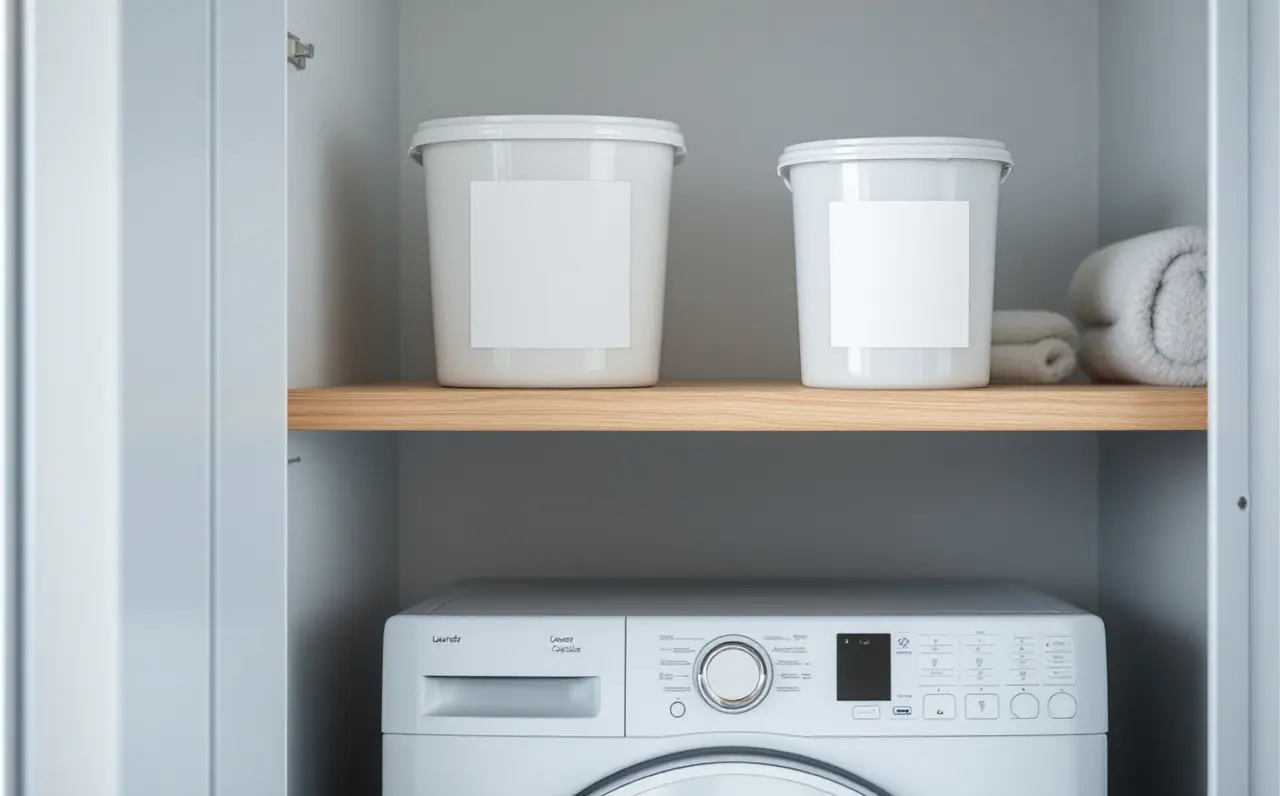
The CPSC's wording is "locked up and out of a child's sight and reach". In practice that means a cupboard above adult shoulder height, with a latch if a child could climb to it, and not on an open shelf over the machine where the tub is visible. If your laundry space has no high cupboard, a lockable box on top of a wall cupboard works.
Never in a jar, bowl or dispenser on display
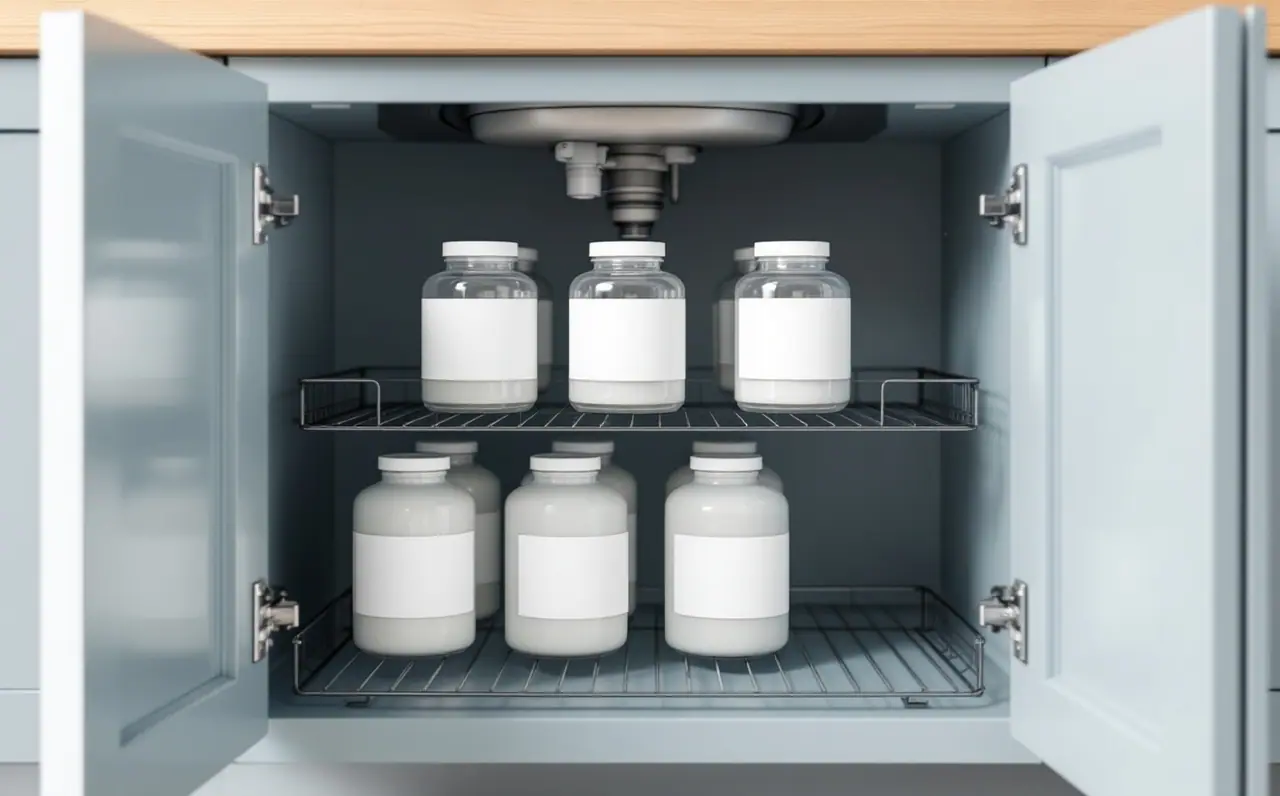
Glass jars of colorful capsules look tidy on a laundry shelf, and that is exactly the problem. Moving capsules out of their opaque tub undoes the part of the design that hides them, and a jar lid is rarely child-resistant. Keep capsules in the container they came in, which is also where the label is.
Dry hands only
Because the film dissolves on contact with water, handle capsules with dry hands, and do not leave a wet capsule sitting on the side. If a capsule has started to go soft or sticky in the tub, the tub has probably been near water or steam, and it needs to move somewhere drier.
Children do not help with this bit
Plenty of children like helping with laundry, and that is a good thing. Let them sort socks or press the start button, but the CPSC's first recommendation is plainly that children should not handle laundry packets. The same applies to older children helping younger ones.
Watch out for visits and holidays
Capsules often turn up in holiday rentals, in grandparents' utility rooms and in the bags of visiting relatives who brought their own. When you arrive somewhere, take a quick look at where the laundry products are and move them up if needed. When people stay with you, ask that any capsules they bring go straight up into your high cupboard.
One product at a time
Capsules are a complete detergent dose. There is no need to add extra products to the drum with them, and laundry is one of the places where people are tempted to mix things for a "stronger" wash. Our piece on the products bleach must never meet explains why combining cleaning products is a bad idea.
If something goes wrong
If you think a child or anyone else may have swallowed a capsule, bitten into one, or got detergent in their eyes or on their skin, call your local emergency number or a poison center now, with the tub or its label in your hand. In the US, that is Poison Help at 1-800-222-1222. In the UK, call NHS 111, or 999 in an emergency. In the EU, call 112. If the person is unconscious, having trouble breathing or having a seizure, call 911, 999 or 112 straight away. Our official help page lists the contacts we point readers to.
For a pet that has chewed a capsule, call your vet or an animal poison line.
Common questions
Are powder or liquid detergents in a bottle any safer?
Every laundry detergent belongs out of a child's reach. The difference with capsules is the format: small, soft, colorful, quick to dissolve and easy to carry off. Whichever you use, read its label and store it high.
Our tub says nothing about child-resistant closures. Does that matter?
It means you should not rely on the lid at all. Treat the tub as if it had an ordinary lid and let height, a latched cupboard and resealing every time do the work.
Can I keep a few capsules by the machine for convenience?
Please do not. Capsules outside their tub have none of the packaging protections, and the top of a washing machine is at exactly the height a toddler can reach with a stretch.
The quickest improvement most households can make costs nothing: take the tub off the top of the machine today and put it in the highest cupboard in the room, lid clicked shut.

Leonie Duval
Leonie writes about laundry, disposal and homes shared with pets. She is the one who knows when the next household hazardous waste day is and what to bring.