Why chemicals stay in their original containers
A drink bottle of weedkiller or an unlabeled spray of bleach is how mix-ups start. Why the original container matters, and how to label a dilution you need.
 By Rosemary Tilson8 min read
There is a moment in most households when decanting seems sensible. The big bottle of bleach is too heavy to lift one-handed, so a little goes into an old spray bottle. White spirit for the paintbrushes goes into a jam jar. Some weedkiller, mixed up for the path, is left in a water bottle for next weekend. Nothing about it feels risky at the time, because the person doing it knows exactly what is in each container.
The trouble is that the knowledge stays in that person's head. Nobody else in the house has it, a visitor certainly does not, and a child who sees a familiar drink bottle has no reason to think it holds anything but a drink. Keeping products in the containers they came in is one of the oldest pieces of household safety advice there is, and it is worth understanding why it matters so much.
What the original container does for you
A product's own bottle is doing several jobs at once.
It carries the label
The label names the product and the maker, lists the hazards, gives the directions for use and storage, and tells you what to do in an emergency. On many products it also carries the hazard pictograms and a signal word such as Danger or Warning; our guide to hazard pictograms explains what those red diamonds mean. On European products you may find a 16-character UFI code, which, as the European Commission explains, helps poison centres identify the exact product and its composition.
All of that disappears the moment the liquid goes into a different bottle.
It tells the person on the phone what they are dealing with
When someone calls a poison center or an emergency number, the first questions are about the product: what is it called, what does the label say, how much might have been swallowed or splashed. The US National Capital Poison Center describes in its article on container transfers how medical staff often have no ingredient information to guide them when a product has been moved out of its own packaging. A labeled bottle in your hand is the fastest answer you can give.
It closes the way it was designed to
Many household products come with child-resistant closures: caps you push and turn, squeeze tabs, trigger sprayers with an off position. In the US, the Poison Prevention Packaging Act of 1970 lets regulators require this kind of special packaging for certain household substances. The US Consumer Product Safety Commission's page on the Poison Prevention Packaging Act describes it as packaging that is significantly difficult for children under 5 to open within a reasonable time, and not difficult for adults to use properly. A jam jar, a sports bottle or a reused spray bottle with a broken lock does none of that.
The CPSC's own household advice is blunt on both points: never put kerosene, antifreeze, bleach, paints or solvents in cups, glasses, milk or soft drink bottles or other food and drink containers, and never move dangerous products into a bottle without a child-resistant closure.
It is made for what is inside
Bottles for bleach, solvents and drain openers are chosen to hold those contents without softening, cracking or leaking. A thin water bottle or a food tub was never designed to hold a solvent or a strong alkali for months.
The containers that cause the most trouble
Drink bottles top the list, because they look like drinks. Close behind come:
- Cups, mugs and glasses used for a quick measure and then left on the side.
- Jam jars and food tubs used for brush cleaner, screws soaking in solvent or leftover paint.
- Old spray bottles with the previous label still on them, now holding something else.
- Unmarked buckets and watering cans with a mixed product in them.
- Anything kept in the fridge. A chemical never belongs in a fridge with food.
If you find one of these in your own home, the fix is quick. If you know for certain what it contains, put it back into the original container if that is still around and the label allows it, or take it to a household hazardous waste collection with a clear note of what it is. If you do not know what it contains, do not pour it away, do not sniff it and do not mix it with anything. Mark it clearly as unknown, keep it out of reach, and ask your local council or city how to dispose of it.
A worked example: the mislabeled spray bottle
Here is a situation that comes up in a lot of homes, described step by step.
A household buys a trigger spray of multi-surface cleaner. When it runs out, the empty bottle is kept, because it is a good bottle. Some months later someone fills it with diluted bleach to clean the shower grout. The bottle still carries the multi-surface cleaner label.
Now walk through what can go wrong.
- Another adult picks it up to wipe the kitchen worktop, thinking it is the mild cleaner on the label. The surface and anything on it gets bleach instead.
- Someone uses it on a toilet bowl that already has an acidic toilet cleaner in it. Bleach and acids together give off harmful gas, which is why our guide on what bleach must never meet treats this as one of the main rules.
- A child gets hold of it. The label suggests a milder product than the one inside, and the trigger may not have a working off position.
- Someone calls for help after a splash or a swallow. They read out the multi-surface cleaner label, and the person on the phone is given the wrong product.
Every one of those problems is solved by the same thing: bleach stays in the bleach bottle, and the multi-surface spray bottle is either recycled or used only for more of the same multi-surface cleaner.
Refill pouches and concentrates
Refill packs are not decanting in the risky sense, as long as you follow the rules printed on them.
- Refill only the bottle the pack names. A pouch of hand soap goes into the hand soap dispenser it was made for, and a cleaning concentrate goes into the trigger bottle sold for it.
- Do not top up one product with another. Two products in one bottle is mixing, even if they are the same color.
- Keep the label on the refill pack until it is empty, and keep the bottle's own label in good condition. If the bottle label wears away, the bottle is due for recycling.
- Store the refill pack in the same place as the original product, high and closed.
When you really need a working dilution
Some labels tell you to dilute a concentrate before use, and some jobs are easier with a small bottle of the diluted product to hand. If the label allows it, here is how to do it with the least risk.
- Use a container meant for the job. A trigger bottle sold empty for cleaning products is better than any old bottle, and far better than a drink bottle.
- Make up only what you will use that day, following the label's own directions. Mixing a big batch to keep is how forgotten bottles appear.
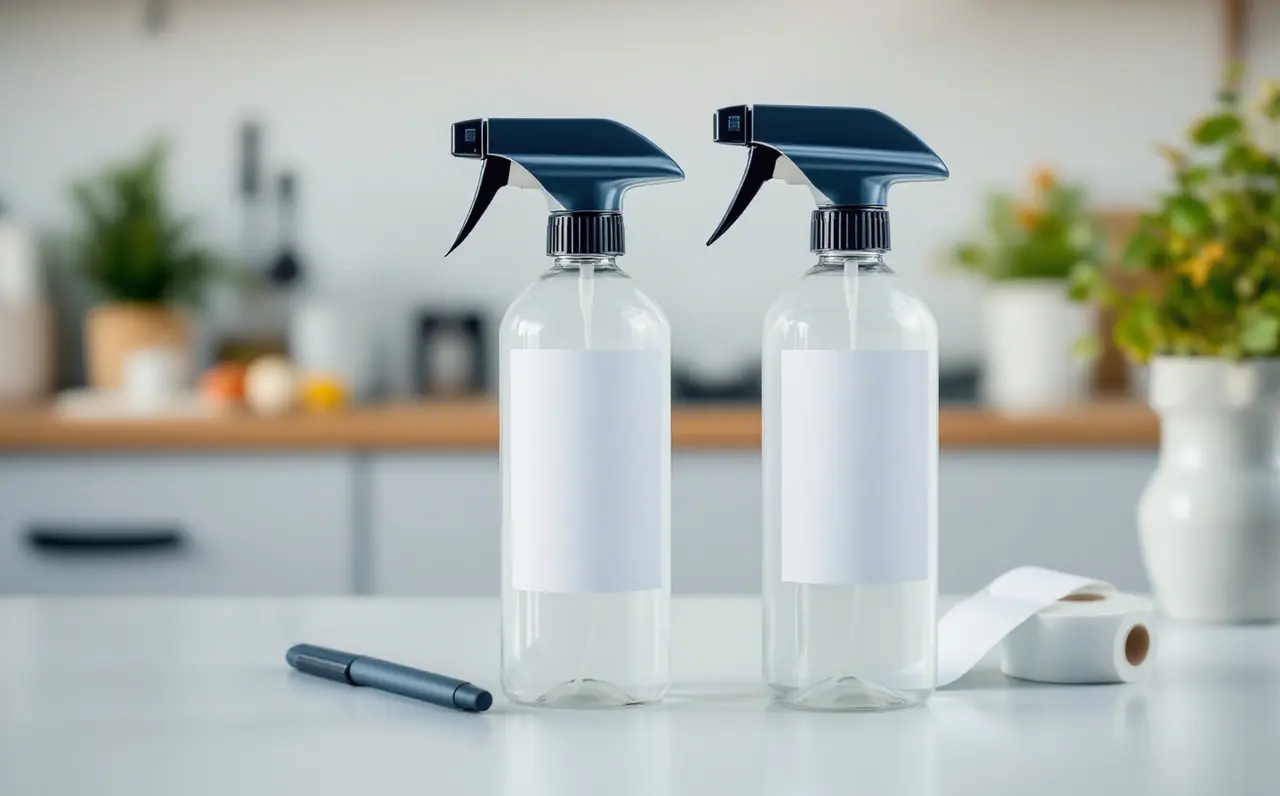
- Label it before you fill it, not after. Write the product name exactly as it appears on the original, the word diluted, the date, and the main warning from the original label.
- If you can, copy or photograph the original label and stick a printed copy on the working bottle. The poison center article above recommends attaching a copy of the original label and the poison center number to any smaller container you use.
- Store the working bottle with the original, out of reach, and empty and rinse it at the end of the job as the label directs.
- Never put a different product into that bottle later.
A sticker that says only "cleaner" is not a label. Neither is a color code that only you understand.
Once you have tidied your containers, it is a good moment to look at where they are kept. Our guide to childproofing the cupboard under the sink walks through a cupboard audit, latch choices and a room-by-room checklist.
Common questions
Is it all right to keep a small amount of a product in a travel bottle?
For cleaning and garage products, no. For personal care products such as shampoo, travel bottles are made for that purpose, but label them, keep them away from small children, and never use the same type of bottle for a cleaning product.
What if the original label is falling off?
Tape it back on with clear tape before it goes. If the label is already unreadable, look up the product on the maker's website by name and finish it or dispose of it. Do not guess what is in it.
Can I pour an old product into a new bottle of the same thing?
Only if it is truly the same product from the same maker and the label does not say otherwise. If you are not sure, keep them apart. Two different formulas can react.
Does this apply to garden products too?
Yes, and perhaps most of all. Weedkillers, slug pellets and lawn feeds are often bought in large packs and used in small amounts, which makes decanting tempting. Keep them in their own packs, closed and high, and mix sprays only as the label directs, for that day.
If someone is exposed
If anyone may have swallowed, breathed in or splashed a product, call your local emergency number or a poison center now, and keep the original container or label with you when you call. In the US, Poison Help is 1-800-222-1222. In the UK, call NHS 111, or 999 in an emergency. In the EU, the emergency number is 112. If someone is unconscious, having trouble breathing or having a seizure, call 911, 999 or 112 straight away. Contacts for other countries are on our official help page.
If you cannot find the original container, say so, and describe whatever you do know: where the product was kept, what it was used for and anything written on the bottle. That is the moment when a properly labeled working bottle earns its place.

Rosemary Tilson
Rosemary has childproofed three family kitchens and one very determined toddler's bedroom. She writes the storage pieces here: latches, heights, cupboards and the habits that keep a bottle where it belongs.