
Getting rid of old paint, solvents and other household hazardous waste
Half-used paint, old weedkiller, dead batteries: what counts as household hazardous waste, where it goes in the US, UK and EU, and how to take it there safely.
 By Leonie Duval8 min read
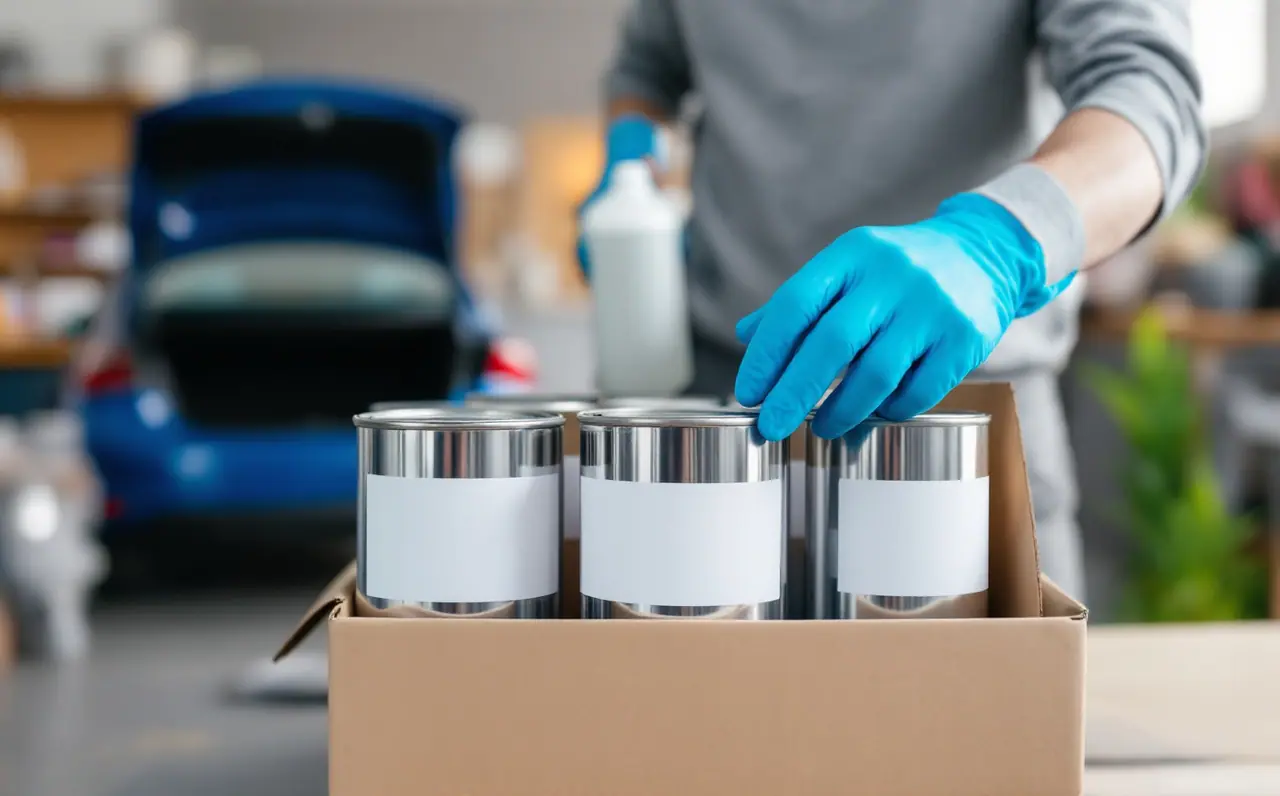
Most houses have the same shelf. It is usually in the garage or under the stairs, and it holds a tin of paint from two kitchens ago, half a bottle of white spirit with a crust round the cap, a box of slug pellets nobody remembers buying, some antifreeze, a can of wood stain and a carrier bag of dead batteries. None of it is being used. All of it is still there because nobody is quite sure what to do with it.
That shelf is household hazardous waste, and there is a proper way out of the house for almost everything on it. This piece explains what counts, where it goes depending on where you live, how to pack it for the trip, and the few things that should never happen to it on the way.
What counts as household hazardous waste
The term comes from the US Environmental Protection Agency (EPA). It describes some leftover household products that can catch fire, react or explode under certain circumstances, or that are corrosive or toxic. The EPA's examples are paints, cleaners, oils, batteries and pesticides. Its household hazardous waste page is a good place to start if you are in the US.
In practice, most collection programs list things like:
- oil-based paint, varnish, wood stain and paint thinner;
- solvents such as white spirit, mineral spirits, acetone and turpentine;
- weedkillers, insecticides, slug pellets and other garden chemicals;
- pool chemicals;
- drain openers, oven cleaners and other strong cleaners;
- motor oil, antifreeze, brake fluid and fuel;
- batteries, especially lithium and button cells;
- fluorescent tubes and compact fluorescent bulbs, which contain mercury;
- aerosols that are not empty.
The hazard pictograms on the label are a good clue. A product carrying the flame, corrosion, skull or environment symbol is very likely to need a drop-off rather than the bin.
Where it goes in the US
Federal hazardous waste law has an exclusion for household waste. The EPA explains that waste generated by normal household activities is excluded from the federal definition of hazardous waste, which means the programs that collect it are run by states and local governments, and the rules vary from place to place.
The EPA suggests contacting your local environmental, health or solid waste agency to find out about permanent or periodic collections near you. In practice that usually means one of three things:
- A permanent drop-off site, often at a transfer station, landfill or recycling center, with set opening hours.
- Collection days, where the county or city sets up a temporary site for a morning or a weekend.
- Retail or business take-back for particular items, such as auto parts shops or garages that accept used motor oil, or stores with battery and bulb collection boxes.
If your area has neither a permanent site nor a collection day, the EPA's advice is to check whether local businesses will take certain products. Some counties also publish searchable "what goes where" lists, which are the quickest way to answer a question like "can this go in the trash?"
Latex paint versus oil-based paint
This is one of the most common questions about disposal. The answer depends on where you live, so check your local list, but the pattern is common. Fairfax County in Virginia, for example, lists paint, thinners, stains and varnishes among the household hazardous waste it collects, while saying that latex (water-based) paint can be left to dry out and the container then put in the regular trash. If you cannot dry it, you can bring it to one of the county's sites. Other places want all paint brought in, and some have paint take-back programs at shops. Treat oil-based paint as hazardous waste unless your local list says otherwise.
The label tells you which kind you have. Look for "water-based", "acrylic" or "latex", or the clean-up instructions: if brushes wash out with water, it is usually water-based; if the tin says to clean up with white spirit or mineral spirits, it is not.
Where it goes in the UK
In the UK, your local council is the place to start. Councils run household waste recycling centres (often called the tip), and what each site accepts, and in what quantity, varies. Check your council's list for items like paint, garden chemicals, engine oil, batteries and fluorescent tubes before you load the car, and ask whether it offers a collection for anything you cannot carry. In England and Wales, the government's recycling collections page will point you to your council's information from your postcode.
For electrical items, there is a second route. The government's guidance for retailers says that shops selling electrical and electronic equipment must give customers a way to dispose of their old household item when they buy a new version of the same thing, either through a free take-back service in store or an alternative free service, or by joining the national distributor take-back scheme. Ask when you buy.
Some shops that sell batteries also have a collection box for used ones by the tills, which is worth looking out for.
Where it goes elsewhere in Europe
Across the EU, collecting hazardous waste from households separately from ordinary rubbish is part of EU waste policy, and the European Commission has published guidelines for countries on how to do it. The practical result varies a lot: in some places it is a mobile collection truck that stops in each neighborhood on set days, in others a staffed recycling yard, in others a box at the supermarket for batteries and a separate one for small electrical items. Your town hall or municipal waste service website will have the details.
A worked example: clearing one garage shelf
Here is how I would take that shelf from the start of this piece and empty it in an afternoon. Wear gloves, open the garage door for fresh air, and keep children and pets elsewhere while you work.
- Take everything off the shelf and stand it on a clear surface, in its original container. Do not open anything you do not need to.
- Sort into three groups. First, products that are still good and that you will genuinely use, or that a neighbor, community group or paint reuse scheme would take, in the original labeled container. Second, products that need a drop-off. Third, empty containers and things your local list says may go in the bin.
- Look closely at the containers. The EPA warns that corroding containers need special handling and suggests calling your local hazardous materials official or fire department for instructions. A rusted fuel can or a split bottle of drain opener is not something to load into the car without advice.
- Look for anything that has lost its label or been decanted into a drinks bottle or jar. Collection sites need to know what they are receiving. Our piece on keeping chemicals in their original containers explains why unlabeled products cause so much trouble.
- For batteries, follow the EPA's advice for lithium cells: tape the terminals with non-conductive tape, such as electrical tape, or put each battery in its own plastic bag, and keep lithium and button cells out of household trash and recycling bins. Our guide to button batteries at home covers the small ones.
- Check the collection rules for anything large or unusual. Fairfax County, for instance, takes barbecue-style propane cylinders up to a set size but asks people to return bigger tanks to a supplier.
The car-care products are often the biggest part of the drop-off pile. Our piece on antifreeze, screenwash and brake fluid covers storing them in the meantime.
Never mix, never pour
Two rules matter more than any other.
First, never combine leftovers. It is tempting to pour two half-tins of thinner together or tip the dregs of several cleaners into one bottle to save space. The EPA warns that incompatible products might react, ignite or explode, and that mixed waste may no longer be recyclable. Keep every product separate, in its own container, with its own lid.
Second, do not get rid of hazardous products down the drain, on the ground, into a storm drain or, in some cases, in the regular trash. The EPA lists all of these as improper disposal that can pollute the environment and harm people, including sanitation workers and septic or wastewater systems. Remember too that "empty" containers can still hold residue, so handle them with the same care.
Packing it for the trip
Fairfax County's guidance on packing and transporting household hazardous waste is a clear example of what most programs ask:
- keep products in their original containers, with lids tightly sealed, and do not mix them;
- label anything that is not in its original container;
- put a leaking container inside a larger plastic container with a tight-fitting lid;
- stand everything upright in a cardboard box so nothing tips over, and do not use plastic bags;
- carry the boxes in the trunk of a car or the back of a pickup, and keep the car ventilated if anything has to ride in the passenger compartment;
- keep flammable products out of direct sunlight and away from heat, sparks and flames, and do not smoke.
To that I would add: go straight to the site and back, keep the trip as short as you can, and do not leave a boot full of solvents sitting in a hot car park while you do the rest of your errands.
If something goes wrong while you sort
Old products sometimes leak, fume or splash when you move them. If anyone may have swallowed, breathed in or splashed a product, get away from the fumes into fresh air and call your local emergency number or a poison center now, with the container or its label in your hand. In the US, that is Poison Help at 1-800-222-1222. In the UK, call NHS 111, or 999 in an emergency. In the EU, call 112. If someone is unconscious, having trouble breathing or having a seizure, call 911, 999 or 112 straight away. Our official help page has the contacts we point readers to. For a pet, call your vet or an animal poison line.
Buying less next time
The cheapest drop-off is the one you never need. Buy the smallest tin of paint or bottle of weedkiller that will do the job, use it up as the label directs, and write the date you bought it on the lid. Next time you stand in front of that garage shelf, you will know at a glance which products are still useful and which ones are next in the box for the recycling centre.

Leonie Duval
Leonie writes about laundry, disposal and homes shared with pets. She is the one who knows when the next household hazardous waste day is and what to bring.