Antifreeze, screenwash and brake fluid in a family garage
Antifreeze tastes sweet, screenwash often holds methanol and fuel cans need closing properly. How to store car fluids in a garage shared with children and pets.
 By Hamish Crowther8 min read
Most garages I have spent time in have the same corner. A jug of antifreeze with a crust round the cap, a half bottle of screenwash, a small tin of brake fluid that was bought for one job and never used again, a fuel can for the mower, a few quarts of oil and a funnel that has seen all of them. In a garage that is also the way into the house, where the bikes live and the dog sleeps on hot days, that corner deserves more thought than it usually gets.
Car fluids are easy to underestimate because they are so ordinary. Most of them are sold in supermarkets and filling stations. Several are seriously harmful if swallowed, some are flammable, and at least one tastes sweet. This piece takes them one at a time, then puts them back on the shelf in a better order.
The rule that sits above all the others: if a child, an adult or a pet may have swallowed any car fluid, got it in their eyes or breathed in its fumes, call your local emergency number or a poison center now, with the container or its label in your hand. In the US that is Poison Help at 1-800-222-1222. In the UK, call NHS 111, or 999 in an emergency. In the EU, call 112. If the person is unconscious, having trouble breathing or having a seizure, call 911, 999 or 112 straight away. For a pet, call your vet or an animal poison line. Our official help page lists the contacts we point readers to.
The usual fluids, side by side
| Product | What is usually in it | The main household concern |
|---|---|---|
| Antifreeze / coolant | Usually ethylene glycol; some use propylene glycol | Sweet taste attracts children and pets; harmful if swallowed |
| Screenwash / windshield washer fluid | Water, detergent and alcohols, which in many products includes methanol | Harmful if swallowed; some concentrates are flammable |
| Brake fluid | Varies by type; read the label | Hazard warnings vary; keep sealed and in its own bottle |
| Gasoline, diesel, kerosene | Fuels | Highly flammable vapors; harmful if swallowed |
| Engine oil, new and used | Mineral or synthetic oils | Messy and harmful to soil and water; used oil needs recycling |
| De-icer, cleaning sprays, waxes | Varies, often in aerosols | Some are flammable; pressurized cans need care in heat |
"What is usually in it" is a rough guide. Formulas vary between brands and between countries, so the label on the bottle you own always wins.
Antifreeze: the sweet one
The US National Capital Poison Center (poison.org) says that most automotive antifreeze contains high concentrations of ethylene glycol. Ethylene glycol has no color or smell of its own (the bright color comes from a dye added to help spot leaks) and it tastes sweet, which is exactly why children and pets drink it. Some brands add a bittering agent, but poison.org notes that studies so far have not shown this to be effective, so a bitter label claim is no reason to relax.
Some antifreeze products use propylene glycol instead, which poison.org describes as less dangerous if swallowed than ethylene glycol. If you are thinking about switching, check your vehicle owner's manual and talk to your mechanic first, because the cooling system may need flushing and the wrong coolant can affect a warranty.
Poison.org's antifreeze advice boils down to a few habits:
- Do not top up or change coolant while children or pets are around.
- Keep antifreeze in its original container, tightly recapped after each use, locked where children cannot see or reach it.
- Never transfer it to another container, especially a food or drink bottle.
- Clean up spills and leaks right away. Spills attract dogs and other animals.
- Do not pour it down storm drains or onto the ground.
That spill point matters most on a driveway. A small puddle under a car with a weeping hose is easy to miss, and a cat or a dog finds it first. If you see a drip, put a drip pan under the car until the leak is fixed, and dispose of what it catches as used antifreeze.
Screenwash: check the label for methanol
Screenwash, or windshield washer fluid in the US, is mostly water and detergent, but the antifreeze part of it is alcohol. Poison.org states plainly that windshield washer fluid contains methanol, and methanol is seriously harmful if swallowed. In the European Union, rules under the REACH chemicals regulation limit methanol in windscreen washing and defrosting fluids sold to the public to a very low level, so EU products rely on other ingredients for frost protection. Products elsewhere, and older bottles bought years ago, may still contain it. The ingredient list or hazard statements on the label will tell you.
Some screenwash concentrates are flammable, so check the label for a flame symbol, and none of them is something anyone should swallow. Two habits help:
- Fill the washer reservoir outside, with the bottle's cap back on before you walk away.
- Never pre-mix screenwash in an old drinks bottle, a jug or a watering can. Mix it straight into the reservoir if the label says to dilute.
Brake fluid and the other small bottles
Brake fluid, power steering fluid, transmission fluid, coolant additives and fuel system cleaners tend to come in small bottles that look much alike. Their hazards differ, and so do the warnings, so I am not going to generalize. Read each label for its signal word and hazard statements, keep each one in its own original bottle with the cap fully closed, and do not mix leftovers to save space. Buy the smallest size that does the job.
Fuel cans
In the US, federal law requires portable containers for gasoline, kerosene and diesel sold to consumers to have child-resistant closures, and later rules added a device that helps stop flame getting into the container. Those features only work when you use them. Close the cap fully every time, even if you will be back in a minute, and replace a can whose cap no longer clicks shut.
Keep fuel cans away from anything that can spark or flame: the water heater, a furnace, a chest freezer motor, a bench grinder. Store only what you need for the mower season. Never use gasoline as a cleaner, and never bring it into the house.
Oil and the trip to the drop-off
Used engine oil, used antifreeze, and old fluids you will never use count as household hazardous waste in most places. The US Environmental Protection Agency's advice on household hazardous waste is to keep products in their original containers, never mix leftovers, never pour them down the drain, onto the ground or into storm sewers, and to contact your local environmental, health or solid waste agency about collection sites or collection days. EPA notes that some local garages accept used motor oil for recycling, and poison.org adds that used antifreeze can be recycled, with some states authorizing service stations to collect it.
For the trip, carry each container upright, closed and in its original packaging, in the trunk rather than the cabin. Empty containers can still hold residue, so they need the same care until they are dropped off.
A garage shelf plan
Here is a worked example of a family garage after one Saturday morning's sort. The garage has a door into the kitchen, a bench along one wall and a car parked inside.
- Take everything off the shelves. Line it up on the bench, out of reach of children and pets while you work.
- Read every label. Anything you cannot identify, anything decanted into another bottle and anything you will never use goes in a box marked for the drop-off.
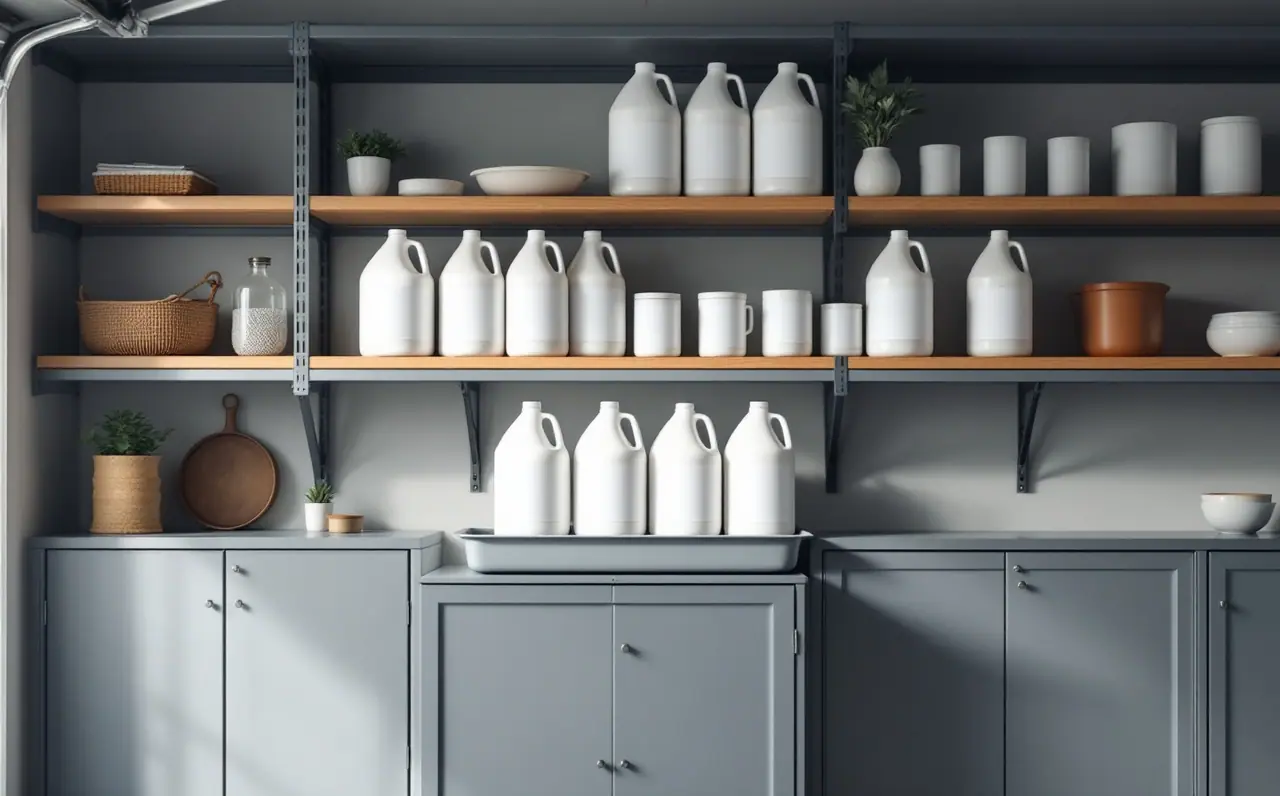
- Put a lockable metal cabinet, or at least a shelf above shoulder height, nearest the bench. Antifreeze, screenwash, brake fluid and the other small bottles go here, upright, in a shallow tray to catch drips.
- Keep fuel cans on their own, at the far end of the garage from the house door and away from the water heater or any appliance with a flame or motor. If you have a detached shed with good ventilation, that may be a better home for them.
- Leave oil on a lower shelf in its own tray, well away from the fuel.
- Keep the funnels and measuring jugs for car fluids with the car fluids, labeled, and never let them back into the kitchen.
- Put a drip pan under the car's usual spot, and check it when you sweep.
When the sort is done, nothing on the shelf is at a toddler's eye level, nothing is in a drinks bottle, and the drop-off box is in the trunk ready for the next collection day. Our pieces on keeping chemicals in their original containers and storing garden chemicals in a shed use the same principles for the rest of the garage.
The garage has an air hazard too
Fluids are only half the story in a garage. A running engine produces carbon monoxide, and the CDC advises never running a car or truck in an attached garage, even with the garage door open. Back the car out before you let it idle, and run mowers, pressure washers and generators outside. A carbon monoxide alarm in the room next to an attached garage is a sensible backstop; our guide to carbon monoxide alarm placement covers where to fit one.
The habit that does most of the work
If I had to pick one habit for a family garage, it would be to put the cap back on and the bottle back on the high shelf before you do anything else, every time, even mid-job. The risky moment is the few minutes when an open jug is sitting on the floor and the adult has gone to look for a rag.

Hamish Crowther
Hamish has spent decades in garages and garden sheds, his own and other people's. He writes about fuels, car-care fluids, paints, carbon monoxide alarms and the batteries hiding in everyday things.