Oven cleaners and caustic sprays: reading the label before a big cooking day
Most heavy-duty oven cleaners are caustic. Before a big cooking day, read the label, clear the kitchen, gear up as it asks and put the can away straight after.
 By Joanna Pettit7 min read
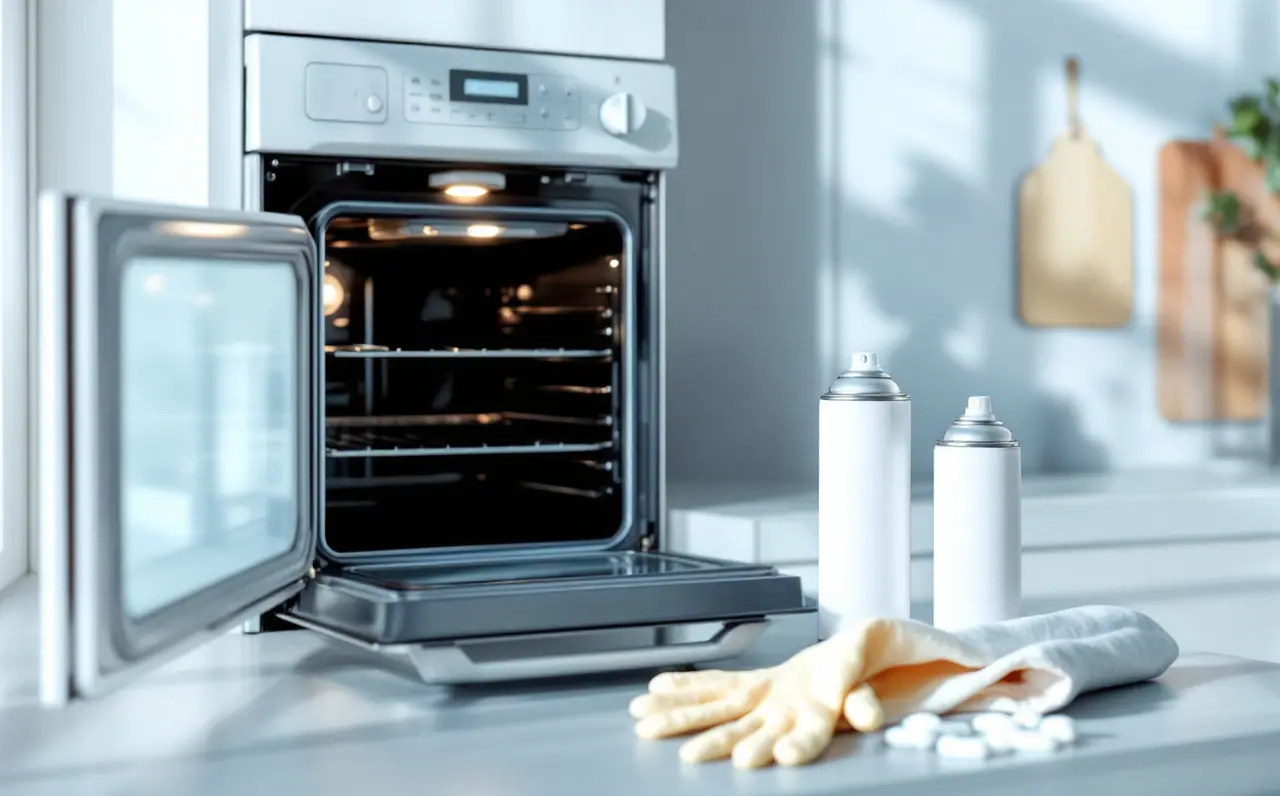
There is a particular evening before a big family meal when the oven door comes down and everyone sees what the last few months of roasting have left behind. That is usually when the oven cleaner comes out, often in a hurry, often with people still in the kitchen. It is also the evening I am most careful, because a heavy-duty oven cleaner is one of the strongest products most of us ever use at home.
This piece is about reading that label before you start, and about the order of things: what to do before the can is opened, while the product is working, and after. It is not about how to clean an oven faster. The label on your product is the instruction that counts, and nothing here overrides it.
What is in a heavy-duty oven cleaner
Many heavy-duty oven cleaners work because they are strongly alkaline. The active ingredient is typically sodium hydroxide (lye, caustic soda) or potassium hydroxide. These break down baked-on grease, and they do the same to skin and eyes. The US National Capital Poison Center, in its article Caution with caustics, lists oven cleaners alongside drain cleaners and lye as products that contain strong alkalis, and warns that they can cause skin burns and serious eye injuries.
Not every oven cleaner is built this way. Some products use different ingredients and carry milder warnings. That is exactly why reading the label of the can in your hand matters more than anything you remember about the last one you bought.
The label in front of me
Here is how I read a typical caustic oven cleaner label, panel by panel. The exact words on yours will differ, so treat this as a map rather than a script.
The pictograms
On a product sold in Europe, the UK and many other countries, a caustic oven cleaner normally carries the corrosion pictogram: a red diamond showing liquid dripping onto a hand and onto a metal surface. If it is an aerosol, it may also carry the flame pictogram for a flammable aerosol. On US consumer products you may see no red diamonds at all, because US household labels follow different rules. Our piece on the nine hazard pictograms covers what each symbol means.
The signal word
Under the GHS system used in Europe, a product classified as causing severe skin burns carries the signal word Danger. In the US, the Consumer Product Safety Commission lists the signal words used on hazardous household products as POISON, DANGER, WARNING or CAUTION. On a caustic oven cleaner, expect one of the stronger ones.
The hazard statement
The European wording for a corrosive product is "Causes severe skin burns and eye damage" (code H314). A US label will say something similar in its own words, such as "causes burns" or "corrosive". If the can is an aerosol, there will also be a statement that it is under pressure and may burst if heated.
The precautionary statements
This is the part I read twice. Typical lines include:
- "Keep out of reach of children."
- "Wear protective gloves/protective clothing/eye protection/face protection."
- "Do not breathe dust/fume/gas/mist/vapours/spray."
- "Use only outdoors or in a well-ventilated area."
- "Store locked up."
The slashes in the glove line are a menu: the maker is supposed to choose which items apply. If the label on your can asks for gloves and eye protection, it means both, every time, even for a quick touch-up.
The directions for use
This is where the label tells you whether the oven should be cold or warm, how long to leave the product, which surfaces to avoid and how to remove it. Some cleaners must not be used on certain coatings, on self-cleaning or catalytic liners, or on the outside of the oven. Check your oven's manual too. If the two disagree, I don't use that product on that oven.
Before you open the can
Most problems with oven cleaner come from what happens around the oven, not inside it. This is my order of work.
- Clear the room. Children and pets go to another part of the house, with the door closed. The poison center article puts it plainly: do not use these products when children or pets are around. A curious dog nosing at the open oven door or a toddler reaching for a dripping cloth is the risk.
- Open a window and switch on the extractor fan, if you have one, before the first spray.
- Take the food out of the kitchen, or cover it. Put away fruit bowls, chopping boards and the dish rack near the oven.
- Put on the protection the label asks for. For me that usually means long rubber gloves that cover my wrists, glasses or goggles, and long sleeves.
- Read the directions one more time with the can in your hand, not your phone.
- Check that nothing else is in use in the kitchen. No other cleaner is on the counter, nothing is soaking in the sink.
While it works
Most caustic oven cleaners need time to sit. That waiting time is when the kitchen is most hazardous, because the product is spread over a large surface and the room may smell strongly. I close the oven door, keep the window open and stay out of the kitchen unless I need to be there. Anyone who wanders in gets turned around at the door.
A few rules I keep:
- One product only. Never follow an oven cleaner with a second cleaner to "finish the job", and never spray anything else into the same oven while it is working. Our piece on bleach and the products it must never meet explains why combining cleaners is risky.
- Spray downward and away from your face, onto the dirty surfaces, as the label directs. On a hot day it is tempting to lean in to see. Don't.
- Don't heat the oven with product inside unless the directions specifically tell you to.
- If the fumes bother you, leave the room and get to fresh air.
Afterward
Removing the product is part of the job, and the label tells you how. Wipe it out as directed, with gloves still on. Rinse the cloth or sponge well, or throw it away if the label says so, and don't leave it in a sink where someone else will pick it up.
Then:
- Put the cap back on until it clicks and wipe the outside of the can.
- Put it back where it lives straight away: a high cupboard, ideally one that locks, away from food. "Store locked up" on a label is a real instruction, not a figure of speech.
- Take your gloves off by turning them inside out and wash your hands.
- Leave the window open for a while longer.
- Only then let children and pets back into the kitchen.
If you have small children, the cupboard under the sink is the worst place for an oven cleaner. Our guide to childproofing the cupboard under the sink covers moving the strongest products up and out.
If something goes wrong
Caustic products act fast. If someone may have swallowed, breathed in or splashed oven cleaner, call a poison center or your local emergency number now, and have the can or its label with you so you can read out the product name. In the US, Poison Help is 1-800-222-1222. In the UK, call NHS 111, or 999 in an emergency. In the EU, call 112. If the person is unconscious, having trouble breathing or having a seizure, call 911, 999 or 112 straight away. For a pet, call your vet or an animal poison line. For other countries, see our official help page.
A short comparison: aerosol, trigger spray and gel
Oven cleaners come in different formats, and each changes how the label's warnings play out in a real kitchen.
| Format | What to watch | Storage note |
|---|---|---|
| Aerosol foam | Fine droplets can drift toward your face; the can is pressurized and may burst if heated | Away from the cooker, radiators and sunny windows |
| Trigger spray | Set the nozzle carefully; a jet can bounce back off the oven walls | Lock or twist the nozzle closed after use |
| Gel or paste with a brush | Less drift, but easy to get on sleeves and the brush handle | Clean the brush or discard it as the label says, and store it with the tub |
None of these is automatically gentler. The ingredients and the label decide that, not the format.
Do you need a caustic cleaner at all?
The poison center's advice is to buy a caustic product only if nothing else will do the job. For an oven that is cleaned often, regular wiping when it is cool, a liner the oven's maker approves, or a milder product may be enough. For a truly baked-on mess before a big meal, the heavy-duty can may still be the right tool. If you do buy one, buy the size you need, use it with the window open and the children elsewhere, and put it away before the first guest arrives.
One last check: if you inherited an old can from a previous tenant or a relative, read the label as if it were new. If the label is worn away and you can't tell what it is, don't use it. Take it to a household hazardous waste collection instead.

Joanna Pettit
Joanna writes about cleaning products: what the active ingredients are, which ones must never meet, and how to get a job done with fewer bottles under the sink.