Storing weedkiller, slug pellets and fertilizer in a shed or garage
Garden chemicals end up in the shed by default. How to plan that shelf: a locked cabinet, original packs, even temperatures and slug pellets well out of reach.
 By Joanna Pettit8 min read
Garden chemicals rarely get a storage plan. A bottle of weedkiller comes home in spring, a box of slug pellets follows when the hostas get eaten, a bag of lawn feed goes on the floor, and by autumn the shed holds a small collection of products nobody quite remembers buying. The shed is the obvious place for them. It is also the place where they get hot in summer, cold in winter, damp at floor level and easy for a child, a dog or a curious cat to reach when the door is left open. This piece walks through how to set up that shelf properly, with a worked plan at the end.
Two official views on the garden shed
Official advice on sheds is not quite unanimous, and the difference is useful.
The US Environmental Protection Agency suggests that, if possible, pesticides go in a locked cabinet in a well-ventilated utility area or garden shed. Its guidance on storing pesticides safely adds that flammable liquids belong outside the living area and well away from anything that can ignite them, naming a furnace, a car, a grill and a lawn mower, and that products should not go anywhere that floods or where a leak could reach a drain, well or stream.
The UK's Health and Safety Executive is more cautious about the building itself. Its advice for home gardeners says garden sheds and greenhouses are not ideal for storing these products, because they can get very hot in summer or cold in winter, and that products are best kept at an even temperature.
Put the two together and you get a practical rule. A shed or detached garage is acceptable when it is the safest place you have, as long as you choose the coolest, driest and most sheltered spot inside it, lock the products away and keep them off the floor. A greenhouse is not a storage room at all. And if a frost-free, well-ventilated outbuilding or utility area away from the living space is available, it is usually the better choice.
What tends to live on the garden shelf
A typical household collection looks something like this:
- Weedkiller, either as a ready-to-use spray or as a concentrate to dilute.
- Slug and snail pellets.
- Lawn feed, weed-and-feed products and bags of granular fertilizer.
- Ant powder or ant bait.
- A fungicide or insect spray for roses or fruit.
- Fuel for the mower or strimmer, which brings its own fire risk.
Every one of these comes with a label that carries more than the directions for use. It names the active ingredient, gives the storage instructions and states what to do in an emergency. Our guides to hazard pictograms and to keeping chemicals in their original containers explain why that label needs to stay attached to the product for as long as you own it.
The rules that make the biggest difference
Lock it and lift it
Both agencies want these products out of reach of children and pets. A wall cabinet with a lock, fixed at adult head height, covers both at once. If a lock is not possible, a high shelf plus a latch on the cabinet door is the next best thing. The floor is the worst place, because it is where dogs sniff, toddlers explore and damp collects.
Keep everything in its original pack
The HSE says plainly that keeping garden pesticides in their original containers is both a safety measure and a legal requirement in the UK. The EPA warns never to transfer pesticides into soft drink bottles or other containers. Torn bags and split boxes can go, whole, into a sealed, lidded plastic tub with the original label kept with them, so nothing is decanted and nothing loses its instructions.
Close it until it clicks
Child-resistant caps only work when they are fully closed. Screw them down until they stop, check the seal on pouches, and fold and clip bags of granules rather than leaving them open on the shelf.
Mind the temperature
Heat, frost and damp all take their toll on packaging. Labels fade and become hard to read too, which the HSE points out as one more reason not to keep products for years. Keep them off the floor, away from a south-facing window and away from the shed wall that takes the afternoon sun.
Keep groups apart
Store pesticides away from food, animal feed and anything medical, which is the EPA's advice, and that includes bird seed, pet food and the chicken feed bin. Keep fuel separate from everything else and well away from the mower's hot engine. Never store a garden chemical where it can drip onto another one.
Slug pellets need extra care
Slug pellets deserve a paragraph of their own. They are small, they are often colored, they come in a shaker pack that is easy to tip over, and they are scattered at ground level, exactly where pets and small children are. The HSE singles them out and asks gardeners to take particular care to store slug pellets safely to avoid accidental poisoning of children and pets.
In Great Britain, outdoor use of slug pellets containing metaldehyde was banned from the end of March 2022, after advice about the risk metaldehyde poses to birds and mammals. If you find an old box at the back of the shed, check the active ingredient on the label. The government's advice is not to throw small leftover quantities away at home, but to take them to a local authority waste facility. The HSE's online garden database shows which products are currently authorized, and if a product is not listed it is probably no longer authorized and therefore illegal to use. Rules on active ingredients differ between countries, so outside Great Britain check with your national regulator and follow the label of what you have.
Wherever you live, the storage advice is the same: closed pack, locked cabinet, high shelf, and no pellets left in an open saucer or spilled on the shed floor.
Buy less, store less
The easiest storage problem to solve is the one you never create. The EPA's advice is not to stockpile and to buy only what you will need soon. The HSE puts a number on it for UK gardeners: never buy more than you will need for one year. One reason is that products are sometimes withdrawn, and once the period allowed to use them up has passed they become illegal to use.
The same thinking applies to concentrates. The HSE advises never making up more diluted product than you need for that day, and never storing leftover solution, which may not work well later anyway. A sprayer full of diluted weedkiller left in the shed is an unlabeled container by another name.
Using products without creating new hazards
Storage and use overlap. A few habits keep the shed shelf from turning into a problem after each job:
- Read the label before you open the pack, including any instructions about how long to keep children and pets away from a treated lawn or bed, and follow them exactly.
- Measure exactly as the label says. More product is not more effective, and the leftover becomes something else to store.
- Never mix two garden products unless the label of each one says they can be combined. The same rule protects you indoors, as our guide to what bleach must never meet explains.
- Put the pack back in the cabinet and lock it before you start the job, not after.
A worked example: one shed shelf plan
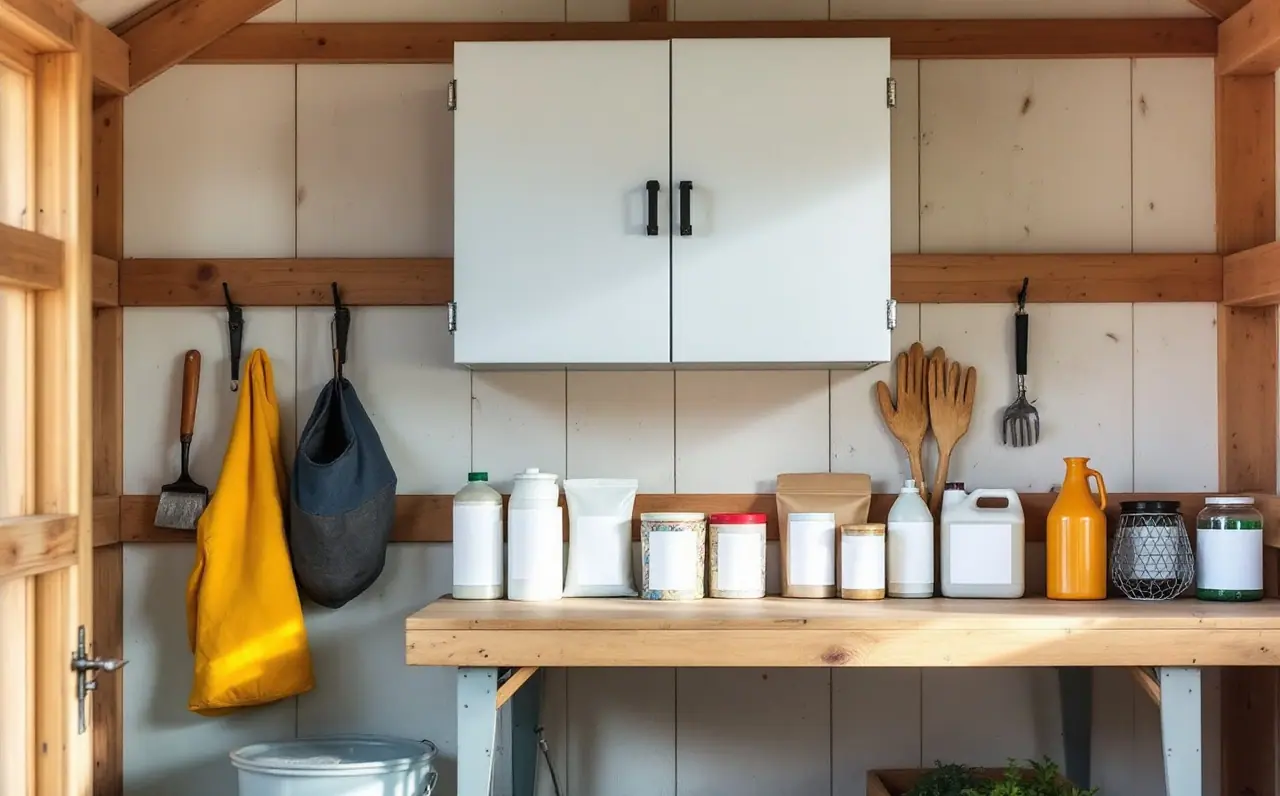
Here is how an ordinary shed collection might be arranged. Picture a wooden shed with a workbench along the back wall, a window on the left and the mower parked on the right.
- Wall cabinet, lockable, fixed above the workbench on the back wall, away from the window. This holds the weedkiller spray, the weedkiller concentrate, the slug pellets, the ant powder and the rose spray, each in its original pack, standing upright. The key lives on a hook in the house, not in the shed.
- A sealed plastic tub on the workbench, below the cabinet. It holds the bag of lawn feed, folded and clipped, plus a part-used box of granular fertilizer. The tub keeps damp and mice out and stops spills spreading.
- A shelf at chest height on the right-hand wall, near the door. This is for the fuel can only, closed and upright, away from the mower's engine and away from the cabinet.
- Nothing on the floor except the mower, the watering can and empty pots.
- Once a year, a clear-out. Check every pack against the label: is it still readable, is the pack sound, is the product still authorized where you live, and will you use it in the coming season? Anything that fails goes to the local household hazardous waste or recycling site in its original container.
That plan costs a cabinet, a tub and an hour. It keeps every product labeled, closed, raised and away from fuel, and it makes the annual clear-out quick. The same habits work for car-care products and paints that tend to share the space.
Disposal, briefly
Never pour garden chemicals down a drain, sink or toilet, diluted or not. The HSE notes that in the UK empty plastic and aerosol containers can go in household recycling, but check the label and your council's rules, because instructions vary and some older labels give different advice. Ask your local council about part-used products, or take them to a household hazardous waste service. Do not burn packaging.
If something goes wrong
If anyone may have swallowed a garden product, breathed in its spray or dust, or splashed it on skin or in the eyes, call your local emergency number or a poison center now, with the product or its label in your hand. In the US, Poison Help is 1-800-222-1222. In the UK, call NHS 111, or 999 in an emergency. In the EU, the emergency number is 112. If someone is unconscious, having trouble breathing or having a seizure, call 911, 999 or 112 straight away. If a pet may have eaten slug pellets, fertilizer or anything else from the shed, call your vet or an animal poison line at once, and take the pack with you. Our official help page lists the contacts for other countries.
The last step after any garden job is the one that matters most: put the pack back, close the cabinet and turn the key.

Joanna Pettit
Joanna writes about cleaning products: what the active ingredients are, which ones must never meet, and how to get a job done with fewer bottles under the sink.